Indian Ocean
Kensuke's KingdomThe Indian Ocean is both a route and a threshold in the family’s voyage: it stretches between Africa and Australia as a seemingly empty expanse, but its waters also make separation, drift, and rescue possible. For Michael, who records the journey in a log, the ocean changes from a space of shared adventure into a place of near-fatal isolation.
Route and Passage
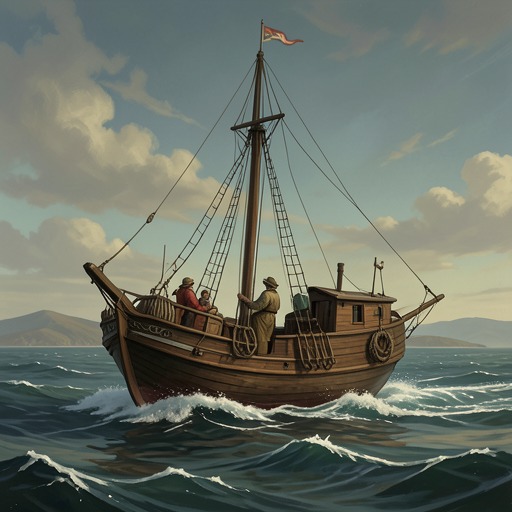
The family’s account of the voyage is anchored by a ship’s log and Michael’s own short, private entries, written during night watches. The record turns ocean travel into a sequence of measured distances, dates, and changing conditions. Although the family planned to cover about two hundred miles a day, the first week brought them only about fifty miles per day; bad weather in the Bay of Biscay battered the Peggy Sue before it reached Spain. Such delays establish that the route is never simply a line on a chart: wind and sea determine how quickly the family can move and how secure they feel.
By October, the family was travelling down Africa’s west coast. Michael saw Africa in the distance, while his mother used the chart to explain that the wind would carry them farther along the coast before they crossed the Atlantic toward South America. She warned that drifting off course could leave them becalmed in the Doldrums, where a lack of wind might strand them for weeks. The Indian Ocean later appears in Michael’s account as a different kind of expanse: hundreds of miles from land, with no immediate destination visible.
A Family at Sea
The ocean passage makes the family rely on one another in unfamiliar roles. Michael remembers his father as both parent and shipmate, and his mother as the skipper whose intensive study of books and charts prepared her to lead the voyage. Their shared work at the helm and winches, and even in the galley, makes the family a close-working crew; at sea, their confidence in their mother rests on what she has learned and on the tasks they undertake together.
That cooperation is tested by distance and fatigue. Near the Indian Ocean crossing, the family had spent a long stretch at sea since Africa, and Michael says he increasingly loved the quiet of being alone together with the Peggy Sue and the sea. Sight of land nevertheless brought an exuberant change of scale: off Perth, Australia, the family hugged and jumped, celebrating that they had sailed from England halfway around the world on their own. At the same time, Michael’s mother’s recurring stomach cramps made landfall necessary for more than celebration; she promised to see a doctor in Australia.
From Open Water to Danger
The ocean’s apparent emptiness does not mean safety. On February 7, hundreds of miles out in the Indian Ocean, the family was occupied with separate duties: Michael was learning navigation with a sextant, his mother was at the wheel, and his father was below in the galley. In the Peggy Sue’s pitching and rolling, Stella Artois appeared at the bow and suddenly fell overboard.
The family’s practiced man-overboard drill gave them a procedure for responding. Michael shouted and pointed while his father lowered the mainsail and jib and the boat turned back; his mother tried to bring the vessel in slowly and close to Stella. Three approaches failed because the boat passed too fast or too far away. On the final attempt, they drew near enough to haul Stella aboard by her collar and tail. The rescue ended in relief and a reprimand: Michael’s father had not worn his safety harness, and his mother made a strict rule that Stella must wear one whenever she went on deck. The ocean thus turns preparation into immediate action, while exposing how little control a small crew has over distance, waves, and timing.
Separation and Rescue
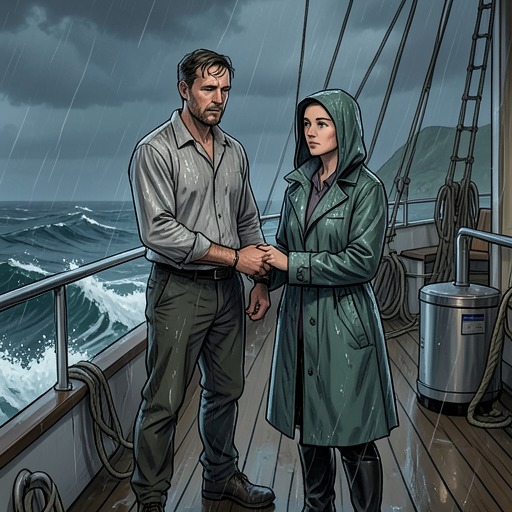
Later, Michael’s own fall into the sea gives the ocean a still more threatening meaning. In darkness he watched the Peggy Sue’s lights disappear and imagined sharks beneath him; convinced that no one could hear his cries, he searched the black water for anything to swim toward. A pale shape proved to be Eddie’s soccer ball, not Stella. Its buoyancy gave Michael something to cling to, but he had to stop calling for the dog and concentrate on saving himself.
The Indian Ocean’s currents and weather also shape Kensuke’s history. After his warship was damaged in battle, its engine continued running even though he could not steer it. A storm drove the vessel to the island; it later broke on the rocks and sank. Years afterward, Kensuke was carried away from that island while fishing for a large fish to smoke. Too old and weak to row back against the wind and sea, he heard a shout and saw a light, then heard another song in the darkness. He reached Michael and Stella and pulled them from the water. The rescue reverses Michael’s sense of the ocean as a place where no help can come: the man who had once drifted ashore himself becomes the person who saves a boy adrift.
Narrative Significance
The Indian Ocean binds distant parts of the story through movement while repeatedly undoing the security that movement seems to promise. For the family, it is part of the route from Africa to Australia and a measure of their achievement; for Kensuke, the sea carries a ruined ship to the island and later carries him away from it. For Michael, it first belongs to a voyage shared with his parents and then becomes a dark space in which he believes he is alone.
Its narrative force lies in that contrast between planned navigation and uncontrollable drift. Charts, sextant lessons, watches, and rescue drills help the family meet danger, but none makes the sea predictable. The ocean separates people across distances that cannot be crossed by will alone, yet it also creates the circumstances of their encounter: Kensuke’s own displacement enables him to find Michael. When the Peggy Sue eventually returns, the family’s arrival restores Michael to his parents, but the ocean’s role in bringing the boy to the island and keeping Kensuke there remains central to both their histories.